- Products
- > Latest Products <
- __________________________________
- Level Magic - Loudness Products
- Digital Audio Processor Devices
- Dynamics & Transmission Devices
- Modular Audio Systems (C8000)
- Software & Applications
- White Papers
- Contact
- News
“Jünger Audio’s C8000 5.1 suite is unique and matches our television production specifications because...” [more]
The Loudness Rollercoaster And How To Survive It
Programme suppliers and broadcasters alike have long been plagued by ‘surprise’ level changes when switching from one source to another. The volume, or loudness, can vary wildly from source to source, wreaking havoc with unattended operation.
Significant differences in loudness often exist between television programming and advertisements. For viewers, this is very irritating because it results in a constant need to reach for the remote and adjust the volume. The problem isn’t just confined to commercials – notable loudness differences can also exist in the same programme, for example with live sports feeds or during a movie or a talk show.
‘Surprise’ level changes are also an issue that re-broadcasters have to deal with, especially Satellite Head End or IPTV providers who have absolutely no control over the broadcasted content’s average operating levels.
All of these facts raise various questions: are the loudest programmes really the best? Is loudness any guarantee of quality? And why worry about it when this is something broadcasters and viewers have been dealing with for years?
The problem is that nowadays, with a much broader content offering and so many different viewing and listening tools available (television, internet, mobile devices, DVDs), what used to be seen as an annoying side effect has become a major concern. Audiences are tired of watching TV with the remote control glued to their hands and the programme makers and presenters are equally unhappy. Complains are raining in from everywhere, to the extent that even Governments are getting involved by considering legislation to address this issue. The people with their backs against the wall are the broadcasters and network operators who are not only being blamed for the problem but also being asked to sort it out.
Broadcast playout centres receive radio and TV programmes from an incoming source and then distribute them on to the viewer. Sometimes, prior to analogue transmission, the sources are modulated and the frequency converted into different channels. In the digital environment sources are received and decoded before new encoding and multiplexing is carried out prior to further distribution.
With the migration to HDTV services the problem of loudness becomes even more relevant as the audio for most digital HD services is transmitted in multichannel coded format. The most common standard used is the AC-3 multichannel digital audio coding format, which is also known as Dolby Digital. Today we often see a remarkable difference in loudness between PCM stereo tracks and related 5.1 coded AC-3 streams!
To measure what is happening to the audio signal, broadcasters have usually relied on PPM and QPPM metering. But when you are dealing with loudness it is necessary to introduce another measurement – Loudness Units (LU). The diagrams below show why this is important.
In the upper hand diagram, where the audio stream from various programmes has not been controlled by any loudness device, the loudness level jumps significantly between programmes (represented by the turquoise blue line). The lower hand diagram shows what happens to the same audio stream when the broadcaster HAS introduced a loudness control device – in this case Jünger Audio’s Level Magic system which incorporates an ITU-1770 compliant algorithm to control loudness. The turquoise blue line becomes much flatter, indicating that the loudness level between the various programmes is more consistent, clearly following ITU BS1770 recommendations and
simultaneously still handling peaks (red/pink square), all together making it much easier on the listener’s ear.
To control loudness it is necessary to perform some kind of gain control to level the volume between the various audio sources. Yet to make this acceptable to the viewer, it is important that the gain control is inaudible. To understand this we need to look at the psychoacoustic effects.
The human ear does not recognise changes in the intensity of an acoustical event provided the transition time is long enough. If a gain change is performed at 1dB in three to four seconds, the human ear is physically incapable of noticing that change. This means that if we perform gain changes at a speed that is no faster than 1db/3sec the manipulation will not be perceptible to the listener. We can achieve inaudible automated gain control as long as the circuit doesn’t try to perform gain control too quickly.
There is another psychoacoustic effect that is related to immediate audio level changes. In principal, listening to dynamic sound isn’t something we find irritating. In fact we need to percept different audio levels in order to appreciate the dramatic content of a programme – for example high audio levels heighten excitement and suspense, while lower levels might be used to convey emotions or carry dialogue. If the audio level drops or jumps more than 12 to 14 dB unpredictably from one moment to another it becomes very difficult for our senses to comprehend, and for the listener these unexpected and immediate loudness changes can be very unpleasant indeed.
At Jünger Audio, we became aware of the loudness problem long before most broadcasters even recognised that they had an issue. We knew from the outset that Loudness needed to be handled differently and couldn’t just be measured using ‘peak’, so we developed a solution in the shape of Level Magic™, a comprehensive series of Level control devices that successfully addresses all of the issues broadcaster currently face, both with stereo and 5.1 and with audio from a wide variety of sources.
Our research into these effects has led to the creation of an adaptive loudness control algorithm simultaneously involving three basic circuit designs that enable Level Magic™ to achieve outstanding level control performance. These include an adaptive AGC, a Transient Processor and a distortion-free Brickwall limiter. For the leveller (AGC and Transient Processor) Jünger Audio uses a unique combination of level detectors to
instantly analyze the incoming audio signal. Dependent on the analyses the resulting gain change is applied. Two gain change elements together are working in the chain - the transient processor as the fast gain change element and the AGC as the slow gain control element. As we have already discussed, it is important to perform the AGC slowly so that the resulting gain change stays inaudible at all times. However, setting the AGC in this way makes it very difficult to deal with transients and with fast incoming level changes. To solve this problem we have incorporated the Transient Processor into the signal path, thus allowing Level Magic™ to control transient elements of the audio signal.
The proprietary algorithms in the Jünger System also allow the automatic adjustment of the attack and release times according to the evolution of the input signal over time. This is called Adaptive Processing Control. By monitoring the waveform of the incoming audio, the System can set relatively long attack times during steady-state signal conditions but very short attack times when there are impulsive transients.
The digital implementation of the Jünger Multi-loop design also permits a very short time delay to be introduced in the audio signal path. This allows the gain changing elements to “look ahead” and determine the correction needed, then apply it to the delayed signal just in time to control even the fastest transients. This is particularly important for the limiter, which provides a precisely leveled output signal absolutely free of overshoots (clipping) and free of distortion.
The unique combination of adaptive controlled Multi-Loop algorithm designs makes it possible to create sophisticated audio level control solutions that need very little input from the end user. The Level Magic™ algorithm offers a “set and forget” application. Overall, the signal loudness is under control without artifacts previously associated with such systems. And since the processor is not multi-band, the spectral balance is not touched.
Earlier this year, Jünger Audio introduced an ITU 1770-based level detection algorithm into all broadcast versions of the Level Magic™ hardware processor boxes. As a result, Level Magic™ not only creates consistent audio loudness, but it also complies with the ITU’s loudness control specifications as level detection can easily be switched to ITU mode.
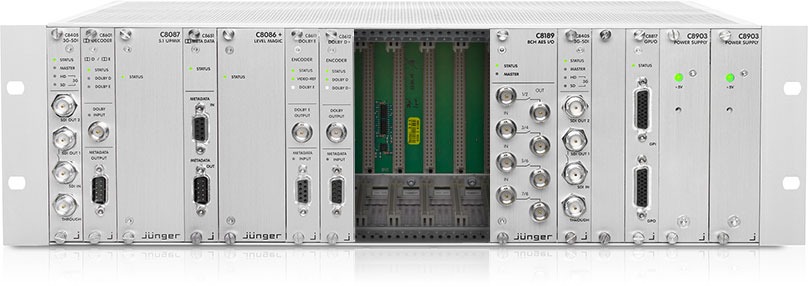
We believe that Level Magic™ offers a complete solution to the loudness problem. Our C8000 modular hardware system incorporates all the necessary modules a broadcaster needs, including 5.1 and stereo audio level control compliant to ITU 1770, AES/EBU
interfacing and HD/SD-SDI embedding, a range of Dolby hardware modules and an optional Metadata Generator that allows related Dolby Metadata to be verified, set and transferred internally to the encoder circuit for use in the coded stream. All of our cards are configured by a web interface and can be monitored by a management system using the SNMP option of the LAN controller card.
To date, Over 6,500 On Air Level Magic processors have been installed worldwide covering application fields such as playout and transmission centres for satellite, cable and IPTV distribution, program transfers with audio level changes, server ingest and many other situations where continuous control of audio level and loudness is important. The modular nature of the system means it can be configured for stereo alone or combined with 5.1 audio signals so that the customer can insert, decode, encode, fail over, read (existing) and generate their own metada without any loudness problems or differences between the flows.
The absence of a loudness reference is certainly creating problems, not to mention heavy debate amongst industry ‘gurus’ as to whether we should all follow the Dolby flag, which targets a reference value for loudness at -31 dBFS, or whether we should find a consensus at around -20dBFS, which is the figure presently being discussed by the EBU’s P-LOUD group.
Admittedly, Junger Audio doesn’t yet know what the final standards for loudness will be – but then, who does? However what we are doing is preparing answers for all options – and recognising that the Loudness issue will always have to be handled somehow. This is just the beginning!
Peter Poers, December 2008